 EN
EN

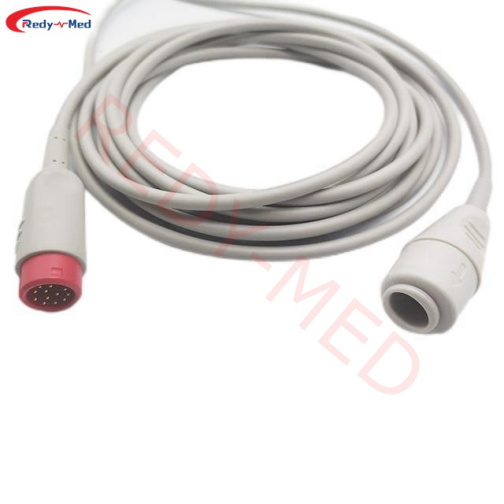
How IBP Cables Ensure Real-Time, Clinically Reliable Blood Pressure Measurement
Signal Integrity from Arterial Catheter to Monitor: The IBP Cable’s Transmission Pathway
Invasive Blood Pressure (IBP) monitoring works by capturing those arterial waveforms through special catheters that turn mechanical pressure readings into tiny electrical signals measured in microvolts. These signals need to make their way through shielded coaxial IBP cables designed specifically to block out electromagnetic interference from all the other gear around them in the ICU environment where there's so much electrical activity going on. The connectors are impedance matched and wrapped in hospital grade insulation to keep the signal clear throughout the 100 to 200 Hz range needed for proper tracking of systolic and diastolic pressures. Standard ECG leads just can't handle what IBP cables do they stay stable even when patients move around or there's background noise in the room. Studies have actually shown that using these optimized IBP cable setups cuts down waveform distortion by about 92 percent compared to regular unshielded cables, which means doctors get real physiological data straight from the source without having to clean it up after the fact.
Calibration, Zeroing, and Dynamic Response: Maintaining IBP Cable Accuracy Under Clinical Conditions
Getting accurate readings over time isn't just about good equipment, it takes proper calibration practices too. Clinicians need to reset the system before starting work so they remove any pressure bias caused by fluids in the lines, basically making sure atmospheric pressure is our starting point. While keeping track of patients, these systems automatically adjust for changes in fluid thickness due to temperature fluctuations. They also run quick tests to check how well they respond to sudden pressure spikes, like what happens during irregular heartbeats or when giving certain medications. Today's invasive blood pressure cables come with tiny sensor technology that meets strict standards for accuracy within plus or minus 1 mmHg throughout their entire measurement range from 0 to 300 mmHg. These modern systems don't suffer from drifting measurements because they aren't reused after being sterilized repeatedly like older models were. The accuracy matters a lot when adjusting medication doses for blood pressure control. Even small errors of around 5 mmHg could lead doctors down the wrong treatment path, potentially causing damage to organs from too little blood flow or injuries from high blood pressure.
Critical Care Applications Where IBP Cable Performance Directly Impacts Patient Outcomes
Continuous Hemodynamic Monitoring in Unstable ICU Patients Using IBP Cable
For critically ill ICU patients who are on vasopressors or have suffered serious trauma, invasive blood pressure (IBP) cables provide continuous, detailed arterial pressure readings that just cant be matched by non-invasive techniques. These cables keep working even when patients experience severe drops in blood pressure, rapid heart rates, or poor circulation conditions where regular blood pressure cuffs simply stop giving useful information. The immediate feedback from IBP monitoring allows doctors to adjust medications accurately, spot hidden bleeding problems earlier, and act quickly to avoid complications like kidney failure or heart damage. According to industry research, using IBP monitoring can cut down treatment delays by around 40% in cases of septic shock because it picks up changes in pressure patterns long before symptoms actually show up clinically. This connection between good cable function and better outcomes means fewer mistakes in diagnosis and ultimately saves lives, though some experts still debate exactly how much impact this makes in practice.
Enhanced Perioperative Management in Cardiac and Neurosurgical Cases with IBP Cable
When performing critical cardiac and neurological surgeries, every millisecond counts and accurate waveforms make all the difference. IBP cables let surgical teams spot sudden drops in blood pressure right away, especially during tricky moments like when clamping the aorta or working on carotid arteries. This early warning gives anesthesiologists time to act before the brain or heart starts suffering from lack of oxygen. Studies specifically looking at carotid endarterectomy show that using high quality IBP waveforms cuts down neurological problems by about 28% compared to regular oscillometric methods. The reason? Doctors can detect when blood flow to the brain is dropping much sooner. With secure connectors that stay put even when patients need moving around, plus compatibility across different monitors, these cables become essential tools for handling sudden blood pressure spikes during brain operations or when coming off heart-lung machines.
Why IBP Cable Outperforms Non-Invasive Alternatives in High-Acuity Clinical Scenarios
IBP cables deliver clinically actionable hemodynamic intelligence where delay, averaging, or artifact renders non-invasive methods inadequate. Their direct arterial coupling, high sampling rate, and engineered signal integrity make them the only modality capable of supporting beat-to-beat decision-making in life-threatening instability.
Accuracy, Latency, and Waveform Fidelity: IBP Cable vs. Oscillometric and Doppler Methods
The oscillometric cuffs we commonly see alongside Doppler devices work through indirect estimation methods that sample data intermittently, which naturally introduces delays and smooths out important waveform details. For instance, when someone experiences sudden drops in blood pressure, oscillometric readings might take anywhere from half a minute to a full minute before flagging this issue. Meanwhile, Doppler technology doesn't offer continuous waveforms at all and simply cannot resolve those subtle diastolic measurements or capture the telltale dicrotic notch. In stark contrast, invasive blood pressure (IBP) monitoring sends unprocessed arterial pressure data at frequencies between 100 and 200 Hz, capturing all those tiny physiological changes including how pulse pressures vary, the speed of systolic upstrokes, and even the shape of that dicrotic notch. Clinicians need these detailed signals to spot problems such as cardiac tamponade or issues with left ventricular outflow. Research published in medical journals shows that using IBP cuts down diagnostic mistakes by about forty percent in emergency situations compared to non-invasive options, meaning doctors get to treat patients faster when they really need it most.
When Only IBP Cable Provides Actionable Physiological Insights—Sepsis, Shock, and Vasoactive Therapy
When dealing with conditions like sepsis, distributive shock, or after cardiac arrest situations, blood pressure levels tend to swing wildly from one moment to the next. Standard cuff measurements simply cannot keep up with these rapid fluctuations. That's where invasive blood pressure (IBP) cables come into play. These devices offer real time beat by beat monitoring capabilities, showing exactly how the body reacts when given medications such as norepinephrine or epinephrine, or during fluid administration tests. Clinicians actually gain valuable insights here. They can tell whether someone is suffering from low blood volume versus widespread blood vessel dilation by looking at things like changes in stroke volume and pulse pressure variations. None of this information would be possible with those standard intermittent readings most hospitals rely on. Studies have shown something pretty remarkable too. Patients receiving vasoactive drugs under continuous IBP monitoring experience around 25 percent fewer deaths than those monitored with regular cuffs. So IBP isn't just about taking better measurements. It really does act as a kind of roadmap for treatment decisions in critically ill patients.
Frequently Asked Questions
What are IBP cables?
IBP cables are specialized cables used in invasive blood pressure monitoring systems to ensure accurate real-time transmission of arterial pressure waveforms from the catheter to the monitoring device.
Why are IBP cables important in critical care?
IBP cables provide continuous, accurate hemodynamic information, essential for timely treatment decisions in critically ill patients, especially those experiencing rapid changes in blood pressure or who are on vasoactive medications.
How do IBP cables reduce errors in blood pressure measurement?
IBP cables maintain signal integrity, minimizing waveform distortion and enhancing accuracy by offering real-time, beat-to-beat arterial pressure readings.
Can IBP cables be used in all types of surgeries?
IBP cables are especially recommended for cardiac and neurosurgical procedures as they provide critical information for immediate intervention during blood pressure fluctuations.