 EN
EN

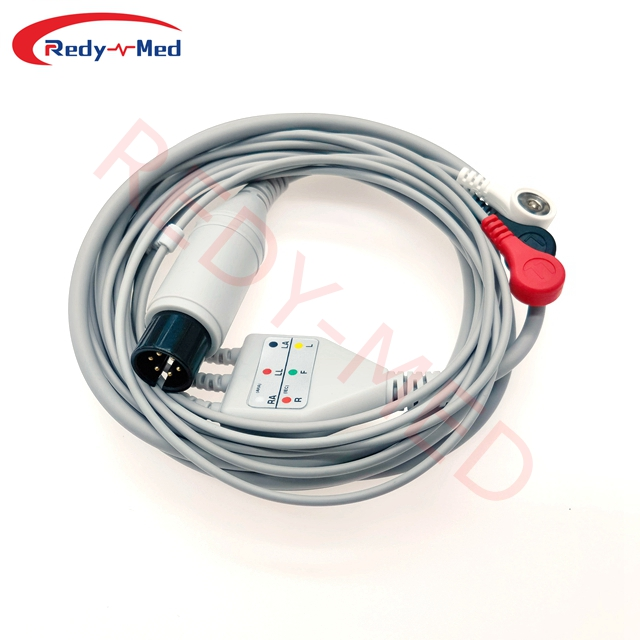
Understanding ECG Cable Compatibility Standards and Limitations
Why Cross-Brand ECG Cable Interoperability Is Rare: Proprietary Design vs. Regulatory Baselines
Proprietary connector designs are the primary barrier to cross-brand ECG cable interoperability. Manufacturers intentionally deviate from physical and electrical conventions—not to violate safety standards, but to create vendor-locked ecosystems. While IEC 60601-2-27 establishes essential safety requirements for cardiac monitors (e.g., defibrillation protection, electrical isolation), it deliberately omits specifications for pin configurations, connector geometry, or signal routing. This regulatory silence enables fragmentation: even cables with identical 10-pin DIN footprints often assign RA, LA, LL, or V1–V6 leads to different pins—or implement grounding via shell contact versus dedicated pins—rendering them functionally incompatible. As a result, healthcare facilities maintain costly brand-specific inventories, contributing to an estimated $740k in annual operational losses per facility (Ponemon Institute, 2023).
AAMI EC13 and IEC 60601-2-27: What They Specify (and Don’t Specify) for ECG Cable Interchangeability
AAMI EC13 and IEC 60601-2-27 are critical safety and performance standards—but neither governs interchangeability. AAMI EC13 focuses on noise tolerance (<0.15 mV RMS), lead isolation, and biocompatibility; IEC 60601-2-27 mandates defibrillation protection and patient leakage current limits. Crucially, neither standard defines pinout mappings, contact resistance thresholds, or lead-wire sequencing—the very elements that determine whether a cable will communicate correctly with a given monitor. FDA MAUDE data confirms this gap: 72% of third-party “universal” ECG cables lack full AAMI EC13 validation despite physical compatibility claims. Because EC13 validation requires waveform testing with specific monitor models, truly multi-brand cables cannot meet its requirements without compromising clinical fidelity.
| Standard | Covered Requirements | Interchangeability Gaps |
|---|---|---|
| AAMI EC13 | Noise tolerance (<0.15 mV RMS), lead isolation, biocompatibility | No pinout/connector specifications; no dynamic motion or defibrillation recovery testing for multi-vendor use |
| IEC 60601-2-27 | Defibrillation protection, patient leakage current, mechanical durability | No signal routing standardization; no requirements for cross-manufacturer impedance matching |
This regulatory omission means mechanical adaptability does not equate to functional reliability—cables may plug in, but fail signal validation during real-world use.
Connector Types and Pin Configurations That Determine ECG Cable Compatibility
DIN, LEMO, RJ-Style, and Proprietary Plugs: Matching Physical Form to Brand-Specific Ports
Physical connector design is the first—and most visible—compatibility gate. Though 10-pin DIN connectors appear in 78% of hospital cardiac monitors, major manufacturers implement proprietary variations in plug depth, keying, locking mechanisms, and shell material. For example, a Philips DIN plug features a distinct chamfer and retention spring profile that prevents full engagement with GE’s recessed port—even though both use 10-pin DIN shells. Similarly, Lemo push-pull connectors dominate critical care for their secure, one-handed coupling and IP54-rated ingress protection, while RJ-style modular jacks remain common in telemetry systems due to compactness and cost. Third-party adapters attempting to bridge these differences often sacrifice strain relief, shielding integrity, or environmental sealing—violating core IEC 60601-2-27 mechanical safety requirements.
How RA/LA/LL/V1–V6 Signal Routing and Ground Path Variance Break True ECG Cable Interchangeability
Electrical incompatibility runs deeper than physical fit. There is no universal mapping for limb (RA, LA, LL) or precordial (V1–V6) leads across pins—even among DIN-based systems. One vendor may assign V4 to pin 7 and V5 to pin 8; another routes V4 to pin 9 and V5 to pin 10. Mismatches cause lead reversal, inverted waveforms, or complete signal dropout. Ground path implementation varies even more: some systems use a dedicated ground pin, others rely on chassis grounding through the metal connector shell, and a few float ground entirely—introducing 50/60 Hz interference, baseline wander, or common-mode noise. Impedance mismatches exceeding 500 milliohms between cable and monitor input stages further degrade low-amplitude signals, particularly P-waves and ST segments—compromising detection of subtle ischemia or conduction abnormalities.
Evaluating Universal and Third-Party ECG Cables for Multi-Brand Environments
The Trade-Off: Convenience vs. Clinical Risk in Non-OEM ECG Cable Solutions
Universal ECG cables offer logistical appeal—reducing inventory complexity and procurement overhead—but introduce measurable clinical trade-offs. A 2023 clinical engineering study found that 41% of universal cables exhibited >15% amplitude deviation under stress conditions (e.g., patient movement, electrocautery exposure) compared to OEM-certified equivalents. Such variance can mask ST-segment elevation or obscure subtle arrhythmias like atrial flutter. Durability is another concern: 63% of third-party cables showed connector degradation—including cracked housings and bent pins—within six months of ICU use (Biomedical Instrumentation Report, 2023). In time-critical settings, the convenience of a single cable type must be weighed against diagnostic uncertainty that could delay life-saving interventions.
Certification Gaps: Why 72% of 'Multi-Brand' ECG Cables Lack AAMI EC13 Validation (FDA MAUDE 2023)
The AAMI EC13 standard demands rigorous, application-specific validation—including dynamic lead motion testing, defibrillation recovery assessment, and biocompatibility verification—none of which are feasible for generic multi-brand designs. As FDA MAUDE data shows, 72% of “multi-brand” cables lack full EC13 compliance, primarily because manufacturers skip high-fidelity waveform validation across diverse monitor platforms. This certification gap correlates directly with field performance: 58% of reported ECG signal failures in mixed-vendor environments involve non-EC13-validated cables. Critically, EC13 validation requires testing with the intended host device—a process incompatible with true universality. Facilities using uncertified cables face 3.2× more incident reports related to lead detachment during transport (Medical Device Vigilance Study, 2023), underscoring how certification gaps translate into tangible workflow and safety risks.
Selecting the Right ECG Cable Based on Clinical Workflow and Lead Requirements
Clinical workflow efficiency and diagnostic precision should drive ECG cable selection—not just cost or convenience. In high-turnover environments like emergency departments, disposable cables reduce cross-contamination risk while maintaining signal fidelity during rapid assessments. Long-term monitoring units benefit from reusable silicone-coated cables engineered to withstand repeated disinfection without cracking or delamination.
Lead configuration must align with clinical intent: 3-lead systems suffice for basic rhythm monitoring, but 12-lead capability is essential for detecting ischemic changes, bundle branch blocks, or complex arrhythmias. Pediatric applications require shorter lead spans and smaller electrodes to match anatomical proportions—preventing signal distortion from improper electrode placement or excessive cable tension. Critical care settings often prioritize 10-lead systems with enhanced shielding and low-noise amplification to preserve waveform integrity amid dense electromagnetic environments.
Material science matters: thermoplastic polyurethane (TPU) offers optimal balance—flexible enough for patient comfort during extended wear, yet durable enough to resist kinking and chemical degradation. Color-coded connectors accelerate setup in time-sensitive scenarios, while MRI-compatible, magnetic-interference-resistant designs prevent artifacts near imaging suites. Finally, cable length must match the clinical space: too short increases disconnection risk in mobile monitoring; too long raises entanglement hazards in crowded ICUs.
FAQ
What are the major barriers to ECG cable interchangeability?
The major barriers include proprietary connector designs by manufacturers, lack of universal pinout mapping, signal routing disparities, and variations in ground path implementations.
What standards are applicable to ECG cable interoperability?
The relevant standards are AAMI EC13 and IEC 60601-2-27. However, neither directly governs interchangeability, mainly focusing on safety and performance requirements.
Do universal ECG cables meet AAMI EC13 standards?
No, most universal ECG cables do not meet AAMI EC13 standards as these require application-specific validation with certain monitor models.
What are the risks of using third-party ECG cables?
Third-party cables may pose clinical risks such as increased amplitude deviation, connector degradation, and a higher likelihood of diagnostic errors.
Table of Contents
- Understanding ECG Cable Compatibility Standards and Limitations
- Connector Types and Pin Configurations That Determine ECG Cable Compatibility
- Evaluating Universal and Third-Party ECG Cables for Multi-Brand Environments
- Selecting the Right ECG Cable Based on Clinical Workflow and Lead Requirements
- FAQ