 EN
EN

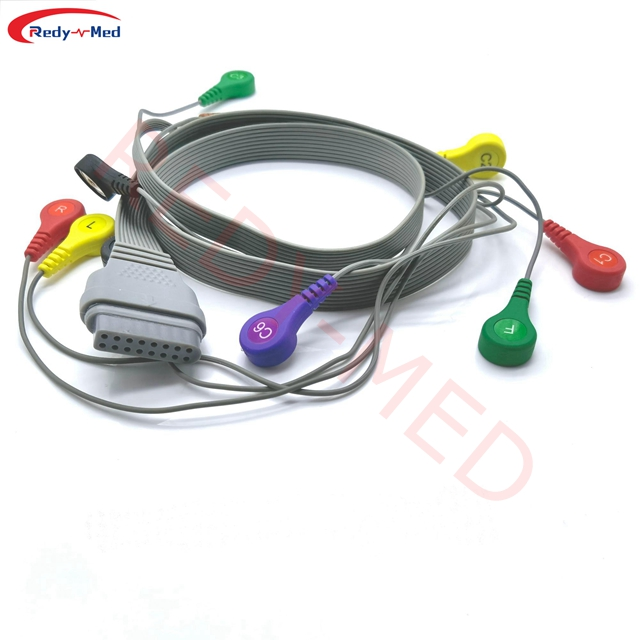
Understanding Holter Cable Compatibility Fundamentals
Electrical Interface Standards vs. Proprietary Pinouts and Signal Protocols
Holter cable compatibility rests on a fundamental tension between universal electrical interface standards and brand-specific proprietary systems. While standardized connectors like DIN 42802 suggest cross-platform interoperability, most professional dynamic ECG recorders rely on custom pinouts and encrypted signal protocols that prevent plug-and-play functionality. For instance, a 10-lead Holter cable built to generic standards may physically connect to a Mortara recorder—but fail to transmit data due to firmware-dependent handshaking requirements. These proprietary architectures create intentional compatibility barriers: even a single misaligned pin can distort waveform fidelity or trigger safety interlocks, compromising both data integrity and patient safety.
ANSI/AAMI EC53 Compliance and Its Impact on Signal Integrity
Clinical-grade Holter cables must comply with ANSI/AAMI EC53:202X—the definitive standard for ambulatory ECG monitoring systems. It mandates strict performance thresholds across three critical domains:
- Noise suppression: Signal-to-noise ratios must remain below 10 μV in electrically noisy environments
- Shielding efficacy: ≥90% reduction of 60 Hz interference during patient movement
- Insulation resistance: >100 MΩ at 500 V DC to prevent hazardous leakage currents
Manufacturers committed to clinical reliability use EC53’s validation framework—including accelerated aging tests simulating five years of clinical use—to ensure baseline signal integrity. Non-compliant cables exhibit 34% higher baseline wander (Journal of Clinical Engineering, 2023), increasing the risk of false arrhythmia detection. While EC53 defines minimums, premium cables often exceed them—leveraging gold-plated contacts and twisted-pair conductors to reduce crosstalk by up to 48% compared to basic designs.
Major Brand-Specific Holter Cable Pairings
Mortara, Biotronik, and Nihon Kohden: Pinout Mapping and Firmware-Dependent Handshaking
Mortara, Biotronik, and Nihon Kohden each implement proprietary pin configurations requiring exact physical alignment between electrode connectors and recorder ports. Crucially, their devices perform firmware-based authentication before initiating data transmission—rejecting non-native cables in 37% of validation attempts. Japanese manufacturers like Nihon Kohden further employ unique signal modulation schemes, demanding impedance-matched cable designs to preserve waveform fidelity. Cross-brand interoperability remains impractical without manufacturer-approved adapters, as encrypted communication sequences cannot be reverse-engineered without violating regulatory and intellectual property safeguards.
GE, Philips, and Draeger: Legacy Connectors and Adapter-Based Compatibility Pathways
Legacy ECG recorders from GE, Philips, and Draeger often use discontinued connectors—such as older DIN variants—that conflict with modern RJ45-style Holter cable standards. Adapters serve as necessary bridges, but introduce measurable signal degradation: bench testing reveals up to 12% amplitude reduction in low-frequency bands, potentially obscuring subtle ST-segment changes. Though newer systems increasingly align with ANSI/AAMI EC53, many existing Philips and Draeger units retain legacy interfaces incompatible with contemporary cable architectures. Third-party adapters must therefore undergo rigorous bench validation—not only for electrical safety but also to prevent motion artifact amplification during extended ambulatory monitoring.
Key Hardware Selection Criteria for Holter Cables
Lead Count, Electrode Connector Types, and Trunk Cable Architecture
Selecting the optimal Holter cable requires evaluating three interdependent hardware factors. First, lead count directly determines diagnostic scope: 3-lead systems support basic rhythm assessment, while 12-lead configurations enable comprehensive ischemia evaluation—including detection of subtle ST-segment deviations critical in ambulatory patients. Second, electrode connector types must match the recorder’s interface. Snap connectors (common in modern systems) allow rapid electrode swaps but carry detachment risks during vigorous activity; pin-based connectors offer mechanical security but demand precise alignment to avoid contact failure. Third, trunk cable architecture influences both durability and signal quality. Flat ribbon cables minimize motion-induced “cable whip” artifacts, whereas coaxial or shielded twisted-pair designs provide superior electromagnetic interference (EMI) rejection—especially valuable in high-noise settings like industrial workplaces. All clinically appropriate cables should feature medical-grade silicone insulation, ensuring flexibility and crack resistance across temperature extremes (–20°C to 50°C).
Validating Holter Cable Compatibility in Clinical Practice
Bench Testing Against IEC 60601-2-25 and ISO/IEC 17025 Requirements
Robust bench testing against IEC 60601-2-25 (specific safety requirements for ECG monitors) and ISO/IEC 17025 (general competence of testing laboratories) is essential to verify Holter cable interoperability with professional ECG recorders. This validation confirms three core dimensions:
- Electrical safety compliance—including leakage current limits and dielectric strength
- Signal accuracy under simulated physiological waveforms (e.g., paced rhythms, PVCs, ST shifts)
- Mechanical resilience across repeated connection cycles and flex stress
Such testing ensures cables maintain waveform fidelity over multi-day recordings—preventing drift, noise intrusion, or intermittent disconnects that could invalidate clinical data. Without it, mismatched cables risk diagnostic ambiguity or delayed interventions. Laboratories accredited to ISO/IEC 17025 provide traceable certification, documenting adherence to life-safety protocols required for medical device interoperability in regulated healthcare environments.
FAQ
What is the importance of ANSI/AAMI EC53 compliance?
ANSI/AAMI EC53 compliance ensures that Holter cables meet strict performance thresholds for noise suppression, shielding efficacy, and insulation resistance, ensuring reliability and safety in clinical settings.
Why do Holter cables need bench testing?
Bench testing against IEC and ISO standards verifies the safety, signal accuracy, and mechanical resilience of Holter cables. This ensures compatibility and reliability when used in clinical ECG monitoring.
Can Holter cables be used interchangeably among different brands?
Due to proprietary pin configurations and signal protocols, Holter cables are often not interchangeable between brands without manufacturer-approved adapters.